
Why infrastructure planning needs new tools: insights from industry leaders
Australia’s infrastructure sector is facing a perfect storm. Tighter budgets, complex approvals, rising sustainability expectations and a rapidly evolving digital landscape mean the early planning stage is now harder—and more important—than ever.
In our recent panel webinar, leaders from Arup, WT Partnership, and the City of Gold Coast joined Terria co-founder Amber Standley to unpack how digital transformation is reshaping infrastructure planning. From data integration challenges to the rise of AI and spatial digital twins, the conversation revealed what’s changing and where new opportunities are emerging.
You can access the full recording here.
Planning has never been more complex
Amber opened with a clear observation from years of user research:
“Projects are getting more complex. Climate volatility, supply chain uncertainty and the expectation to ‘do more with less’ are changing what early-stage planning looks like.” — Amber Standley
Across the panel, a common shift emerged: clients now expect clarity and confidence much earlier, even while variables are becoming harder to predict.
Why early certainty matters: the cost & risk lens
WT Partnership digital engineer Cris Sierra highlighted how much earlier cost pressures are hitting:
“There’s a higher degree of ask for certainty much earlier… clients want better benchmarks upfront and more accessible information to support decisions.” — Cris Sierra
Cris also stressed how fragmented data environments slow down project management and create hidden risks.
“We all have multiple versions of the truth. They were correct at one point, but not at the same time. And that’s where problems echo across a project.”
Sustainability: from intention to proof
Arup’s Digital Advisory Lead Serryn Eagleson noted a major shift in expectations:
“You can’t just say a project is sustainable. You have to prove it and track it from planning through delivery.” — Serryn Eagleson
With sustainability reporting becoming a core requirement rather than a nice-to-have, data integration is now critical. Many large projects are joint ventures with fragmented systems, making interoperability a major barrier.
Serryn emphasised that this isn’t just about tools. It’s about building data foundations that allow teams to collaborate, long before construction begins.
Planning at city scale: the need for evidence and trust
For local government, the challenge is magnified.
City of Gold Coast planning specialist Andrew Saad shared the realities of navigating fast-growing populations, environmental risks, and community expectations:
“It’s a heavily scrutinised, heavily contested space. The clearer and more evidence-based the picture is, the better the conversation goes.” — Andrew Saad, City of Gold Coast
And that “picture” is often literal.
“A picture says a thousand words. The visualisation forces the conversation.”
Whether it’s communicating growth scenarios or balancing competing priorities, visualisation is becoming indispensable for bringing planners, consultants and communities onto the same page.
Where data breaks down and why it matters
All three panelists agreed: the industry still loses enormous amounts of time hunting for information.
Common issues include:
disconnected data sets
inconsistent standards
gaps in foundational land-use data
manual processes that compound technical debt
Digital twins expose these issues quickly. They make the gaps visible, which is confronting - but necessary - for long-term improvement.
Emerging tools: spatial digital twins and AI in practice
Despite the hype, the panel saw real traction and not just experimentation.
Spatial digital twins for clarity and collaboration
Serryn shared the example of the Pasig River digital twin (Arup x RiverRecycle x ADB).
“Once people could actually see the problem, it drove a completely different level of alignment and urgency.”
Cris added that visual context fundamentally changes team dynamics:
“When cost, design and context are visible together, decisions get clearer and meetings go faster.”
AI for smarter data workflows
The clearest AI value today? Automation of repetitive, structured tasks.
cleansing planning data
comparing milestones and cost models
summarising standards
speeding up analysis of complex documentation
As Cris noted, AI’s biggest impact right now is reminding teams to get their data foundations right.
Andrew also highlighted how AI is accelerating internal capability:
“If the prompt is designed well and matched to the right model, it can be hugely powerful.”
What’s next for infrastructure planning
What I love most about FOSS4G is simple: it’s the people. Their honesty and dedication to impactful work is refreshing.
The final question to the panel was simple:
Where is the biggest opportunity next?
Their answers converged around three themes:
1. Real-time, collaborative planning
Digital twins combined with AI will allow teams to optioneer faster, explore multiple scenarios, and integrate complex data in real time.
2. Stronger data governance
The industry needs shared standards, better procurement practices, and clearer ownership models to reduce friction and technical debt.
3. More robust, evidence-based communication
From community engagement to executive approvals, visual tools - and trustworthy data behind them - are essential for navigating contested spaces.
Watch the full panel discussion
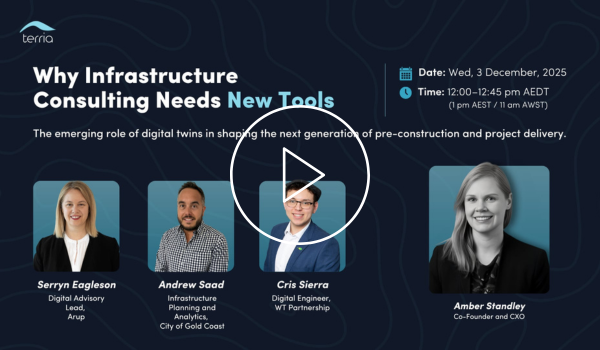
Why infrastructure consulting needs new tools.
You’ll hear first-hand how experienced planners, engineers and advisors are navigating change.

About Terria
Terria makes it easy to build advanced maps and digital twins, so you can see the bigger picture. Our digital maps and spatial digital twin technology make it easy for you to unlock the full potential of your data, enabling faster, smarter decision-making. We help you transform complex data into clear, actionable insights, so you can tackle real-world challenges with confidence and precision.
At Terria, we believe that data transparency has the power to transform how businesses operate, make decisions, and engage with stakeholders—ultimately leading to better outcomes for all. Find out more here https://terria.io/about
To stay updated on all Terria Community activity, follow us on LinkedIn and X
